From summer 1969 through early summer 1972,1)This is a rough estimate; I’ve not yet had opportunity to search for accurate documentation. our family moved to Sénégal, West Africa, and took up residence in the capital, Dakar. My father had accepted a three-year contract with CIDA2)Canadian International Development Agency—a government organization which sought out qualified professionals and experts willing to help for a negotiated period of time in a developing country. Three years was a typical initial term, which could be extended to five assuming both parties were amenable. For details, see https://www.who.int/workforcealliance/members_partners/member_list/cida/en/. It ceased to exist as an independent agency in 2013, as per https://www.huffingtonpost.ca/2013/03/21/cida-closed-budget-2013_n_2926517.htmlhttps://www.huffingtonpost.ca/2013/03/21/cida-closed-budget-2013_n_2926517.html. as a secondary school teacher.
Early experiences
Assignment of a proper domicile was a matter of negotiation with the local authorities. I remember that my father and another Canadian by name of Alain Gervais had many meetings with a Monsieur Diouf on the subject. In the mean time, we were put up in a hotel and ate, for the most part, in restaurants.
Hotel and restaurants
I remember the hotel, an establishment by name of Hotel Atlantique, which was run by a French couple—as, indeed, many things were, at that time, a legacy of the colonial period.
I remember that there was an inner courtyard with rooms surrounding it; whether it was multi-storey or no I can no longer recall. We lived there for some six (6) weeks or so, if memory serves. At least one other Canadian family was there with us, but though I remember the boy (quite a bit younger than myself, going on 10 at the time). In a fit of silliness, I remember tossing a kind of folded cardboard into the toilet and flushing it. It didn’t have the effect I had expected (what would that have been?) and the boy was quite saddened by it; “Je l’aimais bien, ce carton”—I can still see his expression and hear the tone of his voice. I also remember that he and I went on a rampage one afternoon and chopped leaves from the plants growing in the courtyard using a ruler as a sword (I put it in singular because I know I did, but can’t remember about him). Evidently I was quite a naughty child, then.
I don’t recall the procedure for breakfast; we may have eaten in the hotel. I do remember being sent to the baker from time to time to buy a baguette for 25 francs CFA.3)The currency in use at the time in former French West African colonies was known as Communauté financière Africaine, or CFA, for short, at the time we lived there. For more information, see https://en.wikipedia.org/wiki/CFA_franc. I seem to recall that 100 CFA was equivalent to about 25 c Canadian, or the like.
I remember two small anecdotes on that particular subject.
Once, my mum sent me out to buy a half baguette rather than a whole one, and gave me 12.5 francs. What she didn’t realize was that the 0.5 franc piece was actually a French franc, and not valid in Sénégal. 4)Besides being worth a whole lot more, which I, of course, did not appreciate at the time! The vendor pointed this out to me, took 12 francs, and gave me a piece of bread shy of one half.
On another occasion, she sent me to buy a pain de mie, i.e., a (regular?) loaf of bread, to give to a leper who begged at the corner of the street near the hotel.5)There were many such in Dakar at that time; some of them had hand-powered carts (3 or 4 wheels) which operated by pushing the steering wheel to and fro. In most cases, as with this man, they were missing noses and had stubs for fingers and toes; I never saw open sores though I suppose there must have been some of those cases somewhere. I remember hearing that the government kept trying to move them to a special district, and kept failing. When I gave it to him, I made sure to let go as soon as he’d taken hold of his end, for fear that the disease might crawl down the loaf and jump on me. I suppose the poor fellow will have noticed this, and I feel embarrassed now, thinking back on it, but I knew nothing of such things. My mum asked me whether he had been pleased at the gift, and I remember telling her that he went to the corner to see whether anyone was coming, then came back and sat down and immediately began to gnaw on it.
I remember two restaurants: one, by name of Eurasia, was near to us. If we went there, it was rarely and only in the early days, because I’m fairly sure I asked to go back (I had enjoyed the gigot de mouton) and being told that the place was unhygienic or the like. I do recall that we often went to the Hotel Majestique, which was somewhat farther away. We often had celerie rave (grated celeriac in a kind of mayonnaise) and grated carrot in a somewhat spicy oil dressing among other things for appetizer, and one of my favourite dishes (which I still enjoy—though rarely—today, unhealthy as it is) was cervelle: deep-fried battered brain.
Our permanent residence
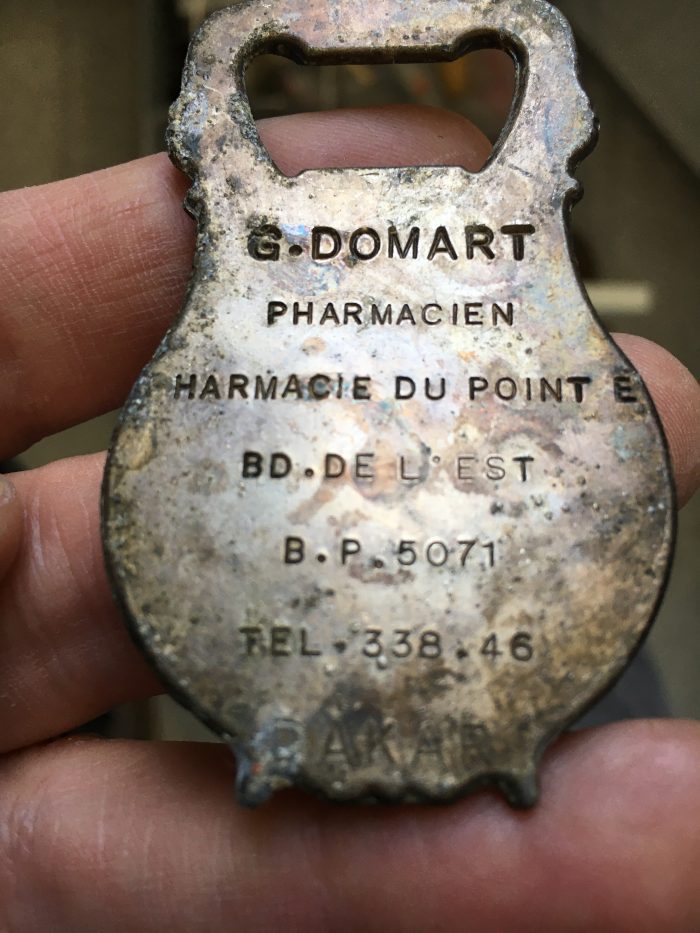
I recall that there were some places we liked and asked to live in, but of which we were told that they were deconventionné, some sort of legal designation, I suppose, to the effect that they weren’t available to such as us. In due course, we did get an apartment, however, in what was then known as Rue 3 bis, in the Point E district, near the corner of Boulevard de l’Est. The former I remember, and the latter I infer from the bottle opener I still have, given to us by the pharmacist down that road.
Although these streets both show up in Google searches these days, it seems the nomenclature may have changed; as far as I can see, places claiming to be on ‘Boulevard de l’Est’ are on what Google calls ‘Boulevard de Saint-Louis’ (this being the name of a northern city of Sénégal). ‘Rue 3 bis’ is even more frustrating, because the places associated with it are scattered in a certain area which makes it difficult to determine which street it actually is. Nearly 50 years have passed since then, so of course much has changed; but as I shall show below, I’m fairly sure that Rue 3 bis is what is now known as Rue PE 23; I assume that ‘PE’ stands for ‘Point E’.
Sketch of the area from memory
Earlier this week (it being now 27 May, 2020), I set about trying to figure out where we lived, and drew a rough6)I’m sure you will have a more accurate term for it than I! sketch, from memory, of the immediate area.
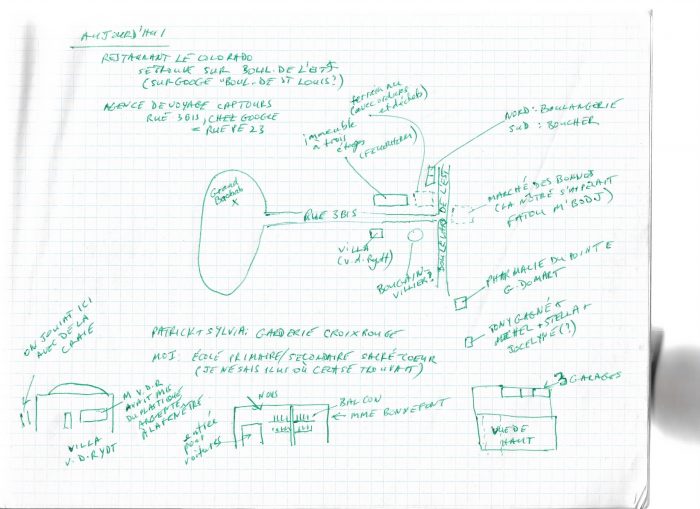
Key here is the large oval area to the west, which was a kind of park area. I remember only two things about the park.
- For a brief time, we had a dog (whom I named Milou, after one in the Tintin series, which I read avidly at the time) whom we (more likely, I!) used to walk there; it was quite upset with him when he grabbed a turd in his mouth and ran off with it
- There was a large baobab tree near the north end. One night (I think), during a storm, it toppled over and we were able to see inside it. The hollow trunk was larger in diameter than I was tall, by quite a bit, as I recall, and it stank badly.
We lived in a three-storey building, on the top floor, west side. There were two apartments on each floor, on either side of a central rectangular staircase, where mouches maçonnes7)These are a kind of wasp which build nests out of mud. were fond of building nests; often I would cringe as I crept up and down the stairs trying to avoid them. On our floor, a French woman by name of Bonnefont (d or t?) lived on south side, and immediately below her was the Pinto-Bull family; the husband was, I think, native though not dark-skinned, the wife Portuguese; their children, from eldest to youngest (if I recall correctly) were Carlos, Fernand, and Carmène. On the ground floor, on the north end of the building, was a drive-through to the back yard, which was mostly sand, and which sported three (3)8)My instinct says three, though I wondered about maybe four; but my sister remembers three as well. I’m pretty sure ours was the second from the left.
Our street ended in a T. On the other side of the road, some African women had vegetable stands under corrugated tin roofs. We bought our vegetables from one of them, known as ‘une bonne’ (literally, ‘good woman’) by name of Fatou M’Bodj. I was often sent there with a basket, and more often than not, she was add something to the basket and say, ‘Ça, c’est cadeau.’ My mum, I think, didn’t much care for the practice as she saw it as a kind of bribe, but I was always to go to Fatou M’Bodj so I guess it didn’t much matter. I do recall that on one occasion, one of the other bonnes heard the comment about the gift and walked off, saying, ‘Cadeau, cadeau ….’
Just east of our building, between us and the corner, was a vacant lot, with stones, and broken glass, and the like. I know about the broken glass because one day I was running through there to cut the corner (contrary to my mother’s instructions, of course), and tripped and fell, and gashed the palm of my right hand badly; I had a splint and bandage for some time, and the scar is still visible).
Heading north on Boulevard de l’Est, on our side of the street, was either one building with two adjoining shops or else two shops, though I think the former. The first was a butcher, from whom I once got a set of osselets (five (5) bones with which children played a game similar to jacks; I remember the shape, though I’m not sure exactly what bones those would be). This was where we would buy merguez, a kind of spicy sausage which I still adore (and also eat sparingly). To the north of that was the baker, where I more often than not was sent to buy a pain de mie. I remember they also sold a cylindrical loaf with a kind of seam across the diameter on the end, which I was not to buy, though I may have accidentally done so once).
In the other direction (i.e., heading south), maybe a block or two away, on the other side of the street was the aforementioned pharmacy, the owner of which was on G. Domart; the name of the place was, not surprisingly, Pharmacie du Point E.
Thus far the salient facts, armed with which I essayed my luck at locating our former home.
Searching for ‘home’
As noted above, with so much time having passed, a great many things can be expected to have changed, but the hope was that something recognizable would have survived. So, first step, take a look at Google Maps.
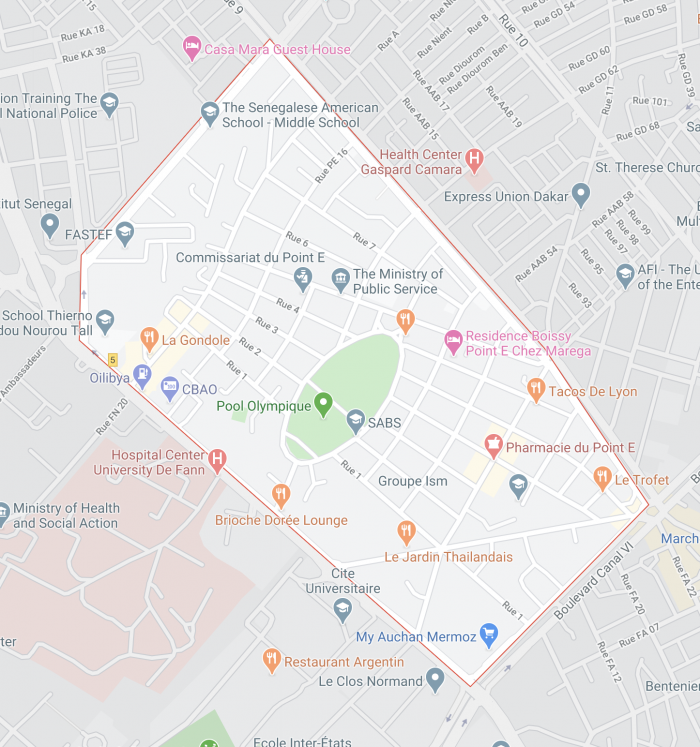
Of note here, and worthy of further investigation:
- A large oval area which might correspond to my memory of the park at the end of the road
- A location identified as ‘Pharmacie du Point E’, which looks to be pretty close to where I remember it having been, at a guess
- A street east of the ‘park’ which, if extended to the other side, would like between ‘Rue 3’ and ‘Rue 4’, in other words, a kind of ‘Rue 3.5’ which could well have been the meaning of ‘3 bis’ (French for ‘3, again’).
A Google search for ‘Pharmacie du Point E, Dakar’, got me the following result:

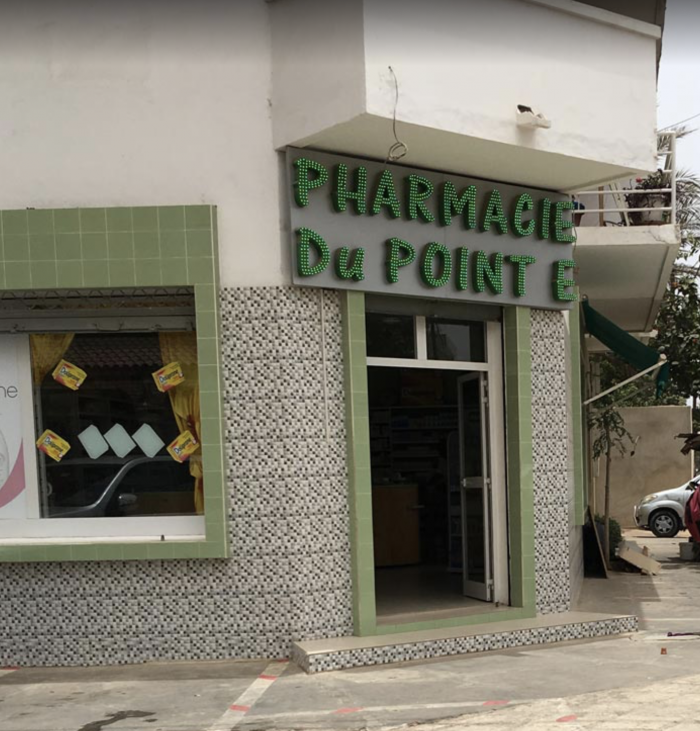
Note the address! Especially as Google Maps actually labels the street as ‘Boulevard de Saint Louis’ …!
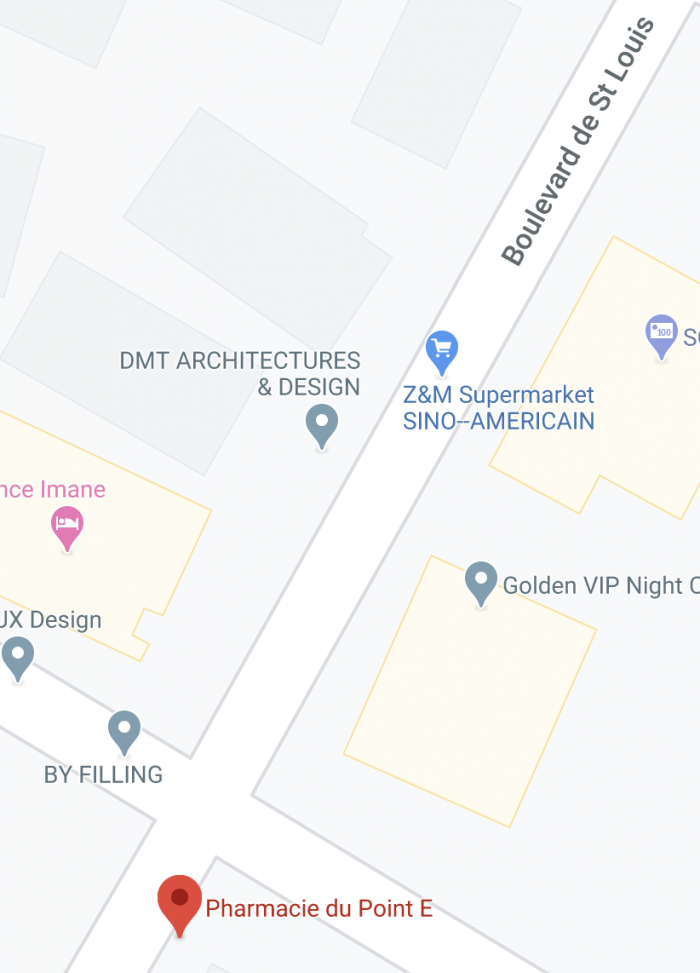
The building looks to be the right shape:
So the next question was, where is/was ‘Rue 3 bis’? Google searches yielded a number of places; for example,
- Groupe Akademia Dakar, at Rue 3 bis x Boulevard de l’Est,Dakar, and just slightly south of west of there
- Groupe ESTEL, at Rue 3 bis x Boulevard de l’Est, Point E, Dakar
among others, but that seemed more a general indicator than a precise one:
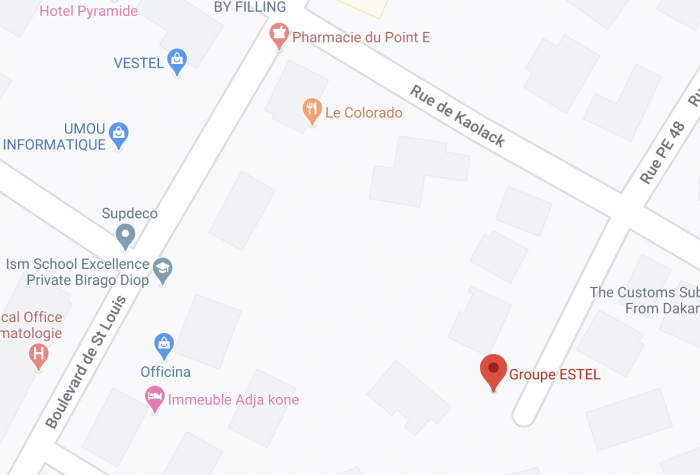
so that was more or less the end of that, though the website for Le Colorado gives its address as ‘Angle du Boulevard de l’Est et de la rue de Kaolack, à coté de la Pharmacie du Point E’, which is at least a kind of confirmation of the presumed identity of ‘Boulevard de l’Est’ with ‘Boulevard de Saint Louis’ ….
Now, assuming that the pharmacy building was the same building as the one we knew, then it was a short walk north to our corner, maybe one or two blocks, if I recall correctly. The likely candidates in that case would be
- ‘Rue PE 23’ (where I assume ‘PE’ is an abbreviation of ‘Point E’) or
- ‘Rue PE 25’
though neither of those streets ended in a T at Boulevard de l’Est/Saint Louis ☹️
At this point, I took a ‘street view’ walk all about the area for an hour or more, as did my sister as well; north, south, west, along the border of the park … but nothing really jumped out immediately.
Notes
| ↑1 | This is a rough estimate; I’ve not yet had opportunity to search for accurate documentation. |
|---|---|
| ↑2 | Canadian International Development Agency—a government organization which sought out qualified professionals and experts willing to help for a negotiated period of time in a developing country. Three years was a typical initial term, which could be extended to five assuming both parties were amenable. For details, see https://www.who.int/workforcealliance/members_partners/member_list/cida/en/. It ceased to exist as an independent agency in 2013, as per https://www.huffingtonpost.ca/2013/03/21/cida-closed-budget-2013_n_2926517.htmlhttps://www.huffingtonpost.ca/2013/03/21/cida-closed-budget-2013_n_2926517.html. |
| ↑3 | The currency in use at the time in former French West African colonies was known as Communauté financière Africaine, or CFA, for short, at the time we lived there. For more information, see https://en.wikipedia.org/wiki/CFA_franc. I seem to recall that 100 CFA was equivalent to about 25 c Canadian, or the like. |
| ↑4 | Besides being worth a whole lot more, which I, of course, did not appreciate at the time! |
| ↑5 | There were many such in Dakar at that time; some of them had hand-powered carts (3 or 4 wheels) which operated by pushing the steering wheel to and fro. In most cases, as with this man, they were missing noses and had stubs for fingers and toes; I never saw open sores though I suppose there must have been some of those cases somewhere. I remember hearing that the government kept trying to move them to a special district, and kept failing. |
| ↑6 | I’m sure you will have a more accurate term for it than I! |
| ↑7 | These are a kind of wasp which build nests out of mud. |
| ↑8 | My instinct says three, though I wondered about maybe four; but my sister remembers three as well. I’m pretty sure ours was the second from the left. |