I was working on another martial arts page having to do with chishi (not yet completed) and decided to start migrating non-work-related bibliography items to the PC.
This meant installing Zotero and the Firefox connector, and GIMP so I can process images for this website.
It was a nice day today (18C), so I removed the snowblower from the tractor, mounted the front loader, removed the backhoe, mounted the tiller, and then tilled the part of the triangular plot south of our driveway to the extent it didn’t have parsnips and garlic growing.
I didn’t experience too much difficulty with the implements this time, and I remembered to remove the drive shaft, too!
Transplanting volunteer garlic
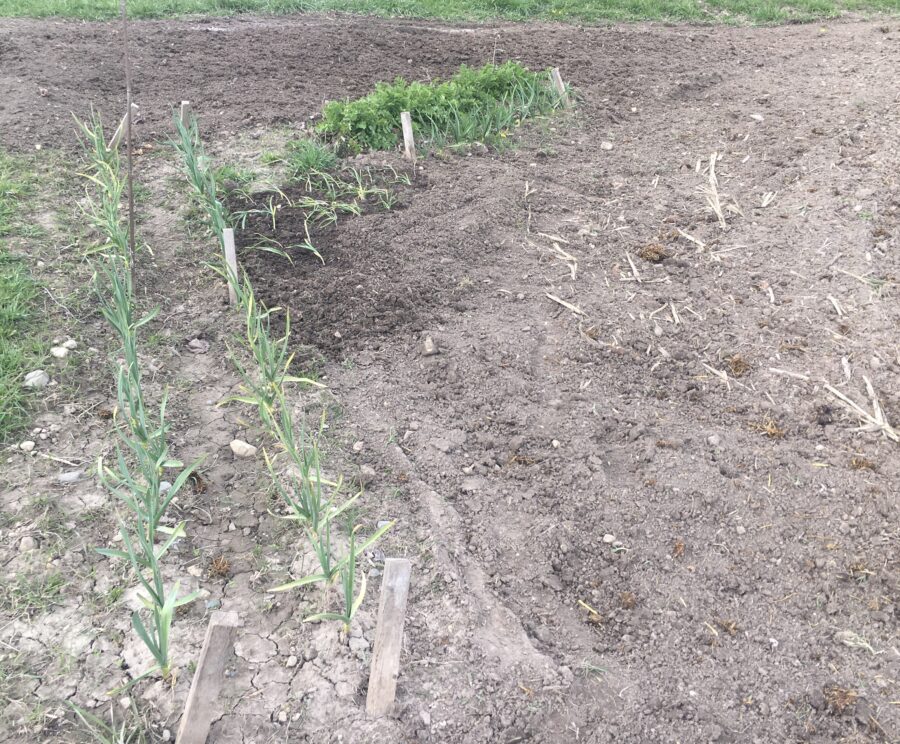
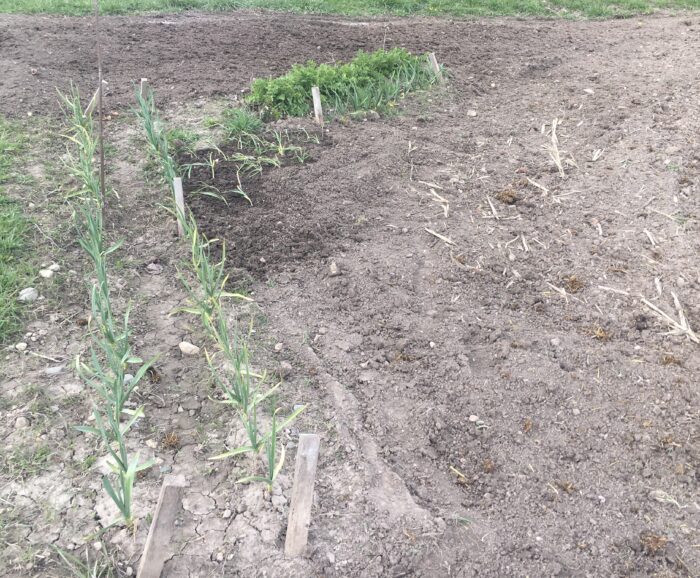
There were 53 volunteer garlic plants, so I dug them up and moved them to the area between the parsnips and the garlic (see the featured image); I planted 15 of the bigger bulbs singly, and the rest in clumps.
The garden triangle after tilling and transplanting on 27 April 2021
First potato planting
In the evening, I remembered that I had wanted to plant some Golden Gems (mini Yukon Gold potatoes) as we’d had some which had sprouted. As it was getting late, I only planted 6 in a N/S row between the driveway and the beginning of the two columns of garlic seen in the photo above.
As a helpful mnemonic tool to myself, I began to set up pages on this site for Hatkusuru Kenpu (a ‘White Crane’ style of Martial Arts, see the appropriate page for details).
Today, I wrote out a sequence of warm-ups as proposed by my friend and instructor D.R. macGregor .
Agai, Jock M. “Resurrection Imageries: A Study of the Motives for Extravagant Burial Rituals in Ancient Egypt.” Verbum et Ecclesia 36, no. 1 (March 25, 2015): 7 pages. https://doi.org/10.4102/ve.v36i1.1457
Number: 1
.
Agrippa von Nettesheim, Heinrich Cornelius. Geomancy. Kila: Kessinger, 1992.
Aken (Dr, Andreas Rudolphus Antonius van. The Encyclopedia of Classical Mythology. Translated by D. R. Welsh. Prentice-Hall, 1965
Allegro, John Marco. Mystery of the Dead Sea Scrolls Revealed. New York: Gramercy Publishing Company, 1981.
Alt, Franz. Jesus--Der Erste Neue Mann. München: Piper, 1989.
Anonyme. Prières et chants du Peuple de Dieu. Paris: Éditions Tardy - A. C. R., 1970.
Armitage, P.L., and Juliet Clutton-Brock. “A Radiological and Histological Investigation into the Mummification of Cats from Ancient Egypt.” Journal of Archaeological Science 8, no. 2 (June 1, 1981): 185–96. https://doi.org/10.1016/0305-4403(81)90023-6
Number: 2
.
Āryānpūr Kāshānī, ʻAbbās, and Manoochehr Aryanpur. Farhang-i nuvīn-i payvastah-i Fārsī-Ingilīsī va Ingilīsī-Fārsī. Lexington, KY, USA: Mazdâ Publishers, 1986.
Ashlag, Yehudah, and Philip S. Berg, eds. The Zohar: Parashat Pinḥas. Rev. ed. New York: Research Centre of Kabbalah, 1994.
Ashlag, Yehudah, and Philip S. Berg. An Entrance to the Zohar. New York: Research Centre of Kabbalah, 1974.
Ashley, Leonard R. N. The Complete Book of Spells, Curses and Magical Recipes. New York: Barricade Books, 1997.
Atkinson, John A. Duelling Pistols and Some of the Affairs They Settled. 1st ed. London, Melbourne, Sydney, Toronto, Johannesburg, Cape Town, Auckland: Cassell & Company LTD, 1964.
Aziz, Robert. C. G. Jung’s Psychology of Religion and Synchronicity. SUNY Series in Transpersonal and Humanistic Psychology. Albany: State University of New York Press, 1990.
Baigent, Michael, Henry Lincoln, and Richard Leigh. The Holy Blood and the Holy Grail. London : Book Club Associates, 1982. https://trove.nla.gov.au/version/21156112.
Bardon, Franz. The Practice of Magical Evocation. Lanham: Merkur Publishing, 2014.
Barlow, J. Stanley. The Fall into Consciousness. Philadelphia: Fortress Press, 1973.
Barrett, Francis. The Magus. Secaucus, N.J: Citadel, 1975.
Baufeld, Christa. Kleines frühneuhochdeutsches Wörterbuch: Lexik aus Dichtung und Fachliteratur des Frühneuhochdeutschen. Studienbuch. Tübingen: Niemeyer, 1996.
Baum, Gregory. Compassion and Solidarity: The Church for Others. CBC Massey Lectures. Toronto: CBC Enterprises, 1987.
Becker, Ernest. The Denial of Death. New York: Free Press, 1985.
Bennet, E. A. Meetings with Jung: Conversations Recorded During the Years 1946-1961. 2nd ed. Zürich: Daimon Verlag, 1985.
Bertman, Stephen. Handbook to Life in Ancient Mesopotamia. New York: Oxford University Press, 2005.
Bibby, Reginald W. Fragmented Gods: The Poverty and Potential of Religion in Canada. Toronto: Stoddart, 1993.
Blair, Heather. “Religion and Politics in Heian-Period Japan: Religion and Politics in Heian-Period Japan.” Religion Compass 7, no. 8 (2013): 284–93. https://doi.org/10.1111/rec3.12054
Number: 8
.
Blyth, Elizabeth. Karnak: Evolution of a Temple. New York, NY: Routledge, 2006.
Botts, Lee, Bruce Krushelnicki, Alun Hughes, Canada Environment Canada Ontario Region, and United States Environmental Protection Agency Great Lakes National Program Office. The Great Lakes : An Environmental Atlas and Resource Book. Chicago, Ill. : Great Lakes National Program Office, U.S. Environmental Protection Agency, 1987. https://trove.nla.gov.au/version/16030738.
Brown, Dan. Angels & Demons. New York; London; Toronto; Sydney: Washington Square Press, 2000.
Brustad, Kristen, Mahmoud Al-Batal, and Abbas Al-Tonsi. Al-Kitaab Fii Taʿallum al-ʿArabiyya: Textbook for Beginning Arabic with Website. 3rd ed. Washington, DC: Georgetown University Press, 2011.
Brustad, Kristen, Mahmoud Al-Batal, and Abbas Al-Tonsi. Alif Baa Madkhal Ilaa Huruf Al-ʿArabiyyat Waʾaswatiha: Introduction to Arabic Letters and Sounds. 3rd ed. Washington, DC: Georgetown University Press, 2010.
Buckler, Scott R. “Sects and Violence: Development of an Inclusive Taxonomy to Hermeneutically Explore the Histo-Philosophical Motivators for the Inception and Development of the Martial Art, Wing Chun Kuen.” ProQuest Dissertations Publishing, 2010. https://search.proquest.com/docview/1779220135?pq-origsite=primo.
Busch, Harald. So war der U-Boot-Krieg. 3rd ed. Bielefeld: Deutscher Heimat Verlag, 1957.
Bux, Ernst, Wilhelm Schöne, Hans Lamer, and Paul Kroh. Wörterbuch der Antike: Mit Berücksichtigung ihres Fortwirkens. 7., durchgesehene und ergänzte Auflage. Stuttgart: Alfred Kröner Verlag, 1966.
Buxani, Shyam D. Salam: Divine Revelations from the Actual God. 1st ed. New York: SAU Salam Foundation, 2003.
Caputi, Natalino. Guide to the Unconscious. Birmingham, Ala: Religious Education Press, 1984.
Case, Paul Foster. The Tarot: A Key to the Wisdom of the Ages. 1st pbk. ed. New York: Jeremy P. Tarcher/Penguin, 2006.
Chadwick, Robert. First Civilizations: Ancient Mesopotamia and Ancient Egypt. 2nd ed. Oakville, Conn: Equinox Pub, 2005.
Chant, Chris, Steve Crawford, Martin J. Dougherty, Ian Hogg, Robert Jackson, Chris McNab, Michael Sharpe, and Philip Trewhitt. Weapons of War Submarines 1776-1940. Weapons of War. London: Amber Books Ltd, n.d.
Charpin, Dominique. Gods, Kings, and Merchants in Old Babylonian Mesopotamia. Publications de l’Institut Du Proche-Orient Ancien Du Collège de France 2. Leuven [Belgium]: Peeters, 2015.
Charpin, Dominique. Hammurabi of Babylon. London: Tauris, 2012.
Cicero, Chic, and Sandra Tabatha Cicero. Creating Magical Tools: The Magician’s Craft. 2nd ed. St. Paul, Minn: Llewellyn Publications, 1999.
Cicero, Chic, and Sandra Tabatha Cicero. Self-Initiation into the Golden Dawn Tradition: A Complete Curriculum of Study for Both the Solitary Magician and the Working Magical Group. 1st ed. Llewellyn’s Golden Dawn Series. St. Paul, Minn: Llewellyn Publications, 1995.
Clee, David A., and William Hildebrand, eds. Through Europe and Asia (Revised). Toronto: Holt, Rinehart and Winston of Canada, 1980.
Downloaded and installed the most recent DLC Builder (2021-04-24) for Rocksmith.1)Note that this software is still in early phases, so updates are fairly frequent.
This tool requires that WWise also be installed and run at least once, which, in turn, requested the installation of the Microsoft .NET framework (the appropriate link being provided at that time).
A how-to discussion regarding DLC Builder was hosted by Alfonso De La Guardia with presenter Cédric Schneider on Saturday, 25 April 2021 through Google Meet. A link to myrecording of the session will be made available soon.
I had a few email exchanges with my friend D.R. recently about my intention to revive my martial arts practice as an exercise and had shared with him my recent findings on the Chinese arts, e.g., Wing Chun, thus Bruce Lee, and his spin-off, Jeet Kun Do (JKD). He asked when I’d be available for a Zoom meet, and I had wanted to wait until my Arabic test was over.
The test was past Monday 19 April 2021, so we arranged for a session that afternoon. It turns out that (among other things) he was curious what had got me thinking about JKD, as that was so radically different from what either of us had done before, and intended primarily as a hard fighting style for real situations.
I explained my interest in Chinese aspects of martial arts, the research I’d done (I’m posting this on a fixed page, currently in progress), and so on. He then shared with me something he’s been pursuing called Hakutsuru Kenpo.1)This programme is aimed strictly at black belts of whatever style, so it’s a good match for me, as it happens, in that regard. It’s an Okinawan thing too, and more similar to his original style (Shorin-ryu) than mine (Shorinji-ryu), but is supposed to be a reconstruction of some kind of Chinese system known as White Crane, and he sent me links to two videos where he introduces it to his students.
I don’t have much interest in systems and ranks and the like, and I particularly like the JKD idea of ‘cross-pollination’ (my word) and taking what works for oneself and leaving the rest. So, exposure to this is just fine with me.
Yesterday, I did the warm-ups; first time I’ve done anything methodical like that in years. So, but the time I was done, I could feel all my muscles and joints as though I’d done a full karate session! And, btw, we’re talking stretches and the like, nothing cardio like push-ups, sit-ups, or what not. But it was a good feeling. I then went to the back yard later in the day, and did some drills against a tree (ostensibly designed to toughen the arms just behind the wrists; don’t worry, without harm to the tree). That worked fairly well, though I hit a knot at one point and did end up with a bit of a bruise.
Today, I watched the video again, did the drill, and used the telephone pole in the front of the house rather than the tree. That works better. I had avoided it yesterday as there are many cars and I felt a bit self-conscious, but tuffy-shitsky, I’ll just have to get over that.
Then I watched the second video, where he demonstrated some other exercises, and one kata (formalized sequence of techniques for practicing) and one kumite (two person version of same, though he demonstrated each person separately, as one will have to do in the short term anyway).
I tried that. The similarity to his style was very clear, and when I attempted the same thing, my motions and so on were rather different. That’s good, in a way, since it suggests that my body was well trained the first time around. It makes it hard to change the routine, but I’m not altogether sure I need to do that. We’ll see how it goes.
In the fall, he plans to offer a two-hour session via Zoom every month on the second Saturday, I believe. I think I’ll join that, since it’s much easier to keep motivated as part of a group than to try to do everything solo. So between now and then, it’s about improving my condition and learning the basics.
For the time being, I have it connected to my old Philips 27″ monitor, but if and when needed, I can connect the Philips 33″ 4k monitor which is now attached to my MacBook Pro.
Then I powered it down and unplugged it as I didn’t have a suitable power bar and surge protector and didn’t wish to take any risks!
This will be my development machine for the PC side of the house, as well as my primary leisure activity machine going forward.
I started working on Rocksmith 2014 custom downloadable content file (CDLC) last year. There is an otherwise excellent version on CustomsForge already, but the author isn’t a bassist and the bass line leaves a lot to be desired. I did try to contact him but without success.
I created a CDLC with just the bass line, and it works quite well; however, it doesn’t quite follow all the standard CustomsForge protocols, so I may perhaps as well start over. In order to keep everything straight, I will chronicle the steps taken here.
Preparing the sound file
Obviously, a sound sound file is essential to a quality product (pun intended). I began with Lucy in the Sky with Diamonds.wav, a sound file taken from the CD, which I placed into a dedicated folder.1)I’m currently using the following structure: Desktop > Rocksmith > CDLC > <name of song and/or artist>. But it’s up to you!
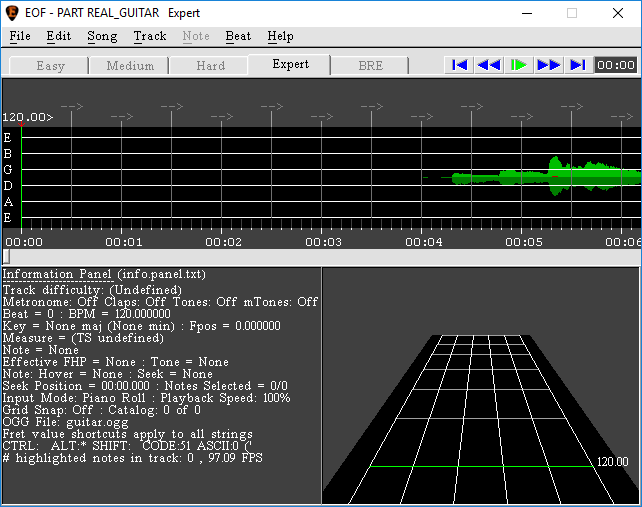
I imported this file into Editor on Fire (EOF) and inspected it:
Launch EOF2)Note: I used to do this on my Mac, running Windows through the Parallels VM, but lately this has become precarious, so I am now doing it on an actual PC for best results.
File > New and select .wav file, then
Song > Waveform Graph > Show (or F5).
As seen in the wave graph, there was an irregular leading silence (in fact with some noise in it). It’s helpful to set this up more precisely, so I loaded the file into Audacity and trimmed the leading and trailing silence, then added the following metadata upon saving:3)According to Firekorn’s tutorial, EOF will load this information if it is available, but that didn’t happen for me….
Artist: The Beatles
Track Title: Lucy in the Sky with Diamonds
Album Title: Sergeant Pepper’s Lonely Hearts Club Band
Track Number: 3
Year: 1967
Genre: Rock
I saved the file into the original folder as Lucy in the Sky with Diamonds trimmed.wav.
Importing into EOF
The next step was to import the newly trimmed file into EOF:
File > New and select the trimmed .wav file
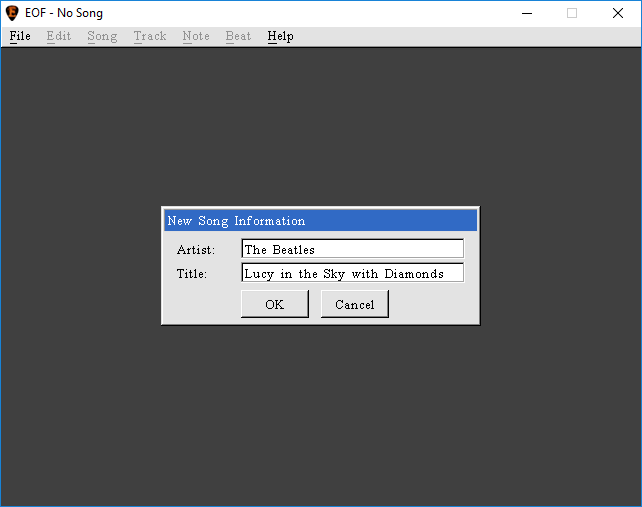
Add the artist and title for EOF to use in the new dialogue:
Once I hit ok, I was prompted regarding where to store EOF’s output files. I like a tidy set-up, so I opted to place all the new stuff in the same folder where the two .wav files already resided.
EOF then converts the input file to .ogg (if it wasn’t already in that format) after asking about encoding quality. I set it to high quality (it seems to default to 96 kbps), but that may just be a waste of space….
Adding leading silence
An important consideration to keep in mind when adding leading silence is that there must be at least one empty measure on the tempo map4)The grid marking measures and intervals in EOF. before the first guitar or bass note, plus 10 seconds. In the case of anacrusis5)I.e., when the first measure is only partial compared to the time signature), add sufficient leading silence so that the first full measure begins in the right spot.
In this instance, there was no anacrusis, so the math was simply
leading silence = 10 seconds + 1 full measure
where full measure was calculated in terms of beats per minute. Given a nominal 124 bpm and 3 beats per measure, that amounts to
10 + 3 / 124 × 60 seconds
and since EOF adds leading silence in milliseconds, that comes to
( 10 + 3 / 124 × 60 ) × 1000 milliseconds
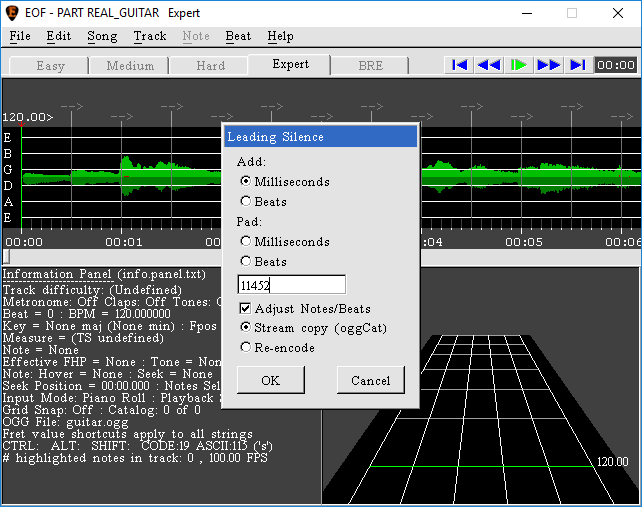
i.e. 11,452 milliseconds rounded. This is done with
Song > Leading Silence:
Note: Sometimes, using the default option Stream Copy (as shown above) fails (as in fact it did with me). In that case, just start that step over using Re-encode and all should be well.
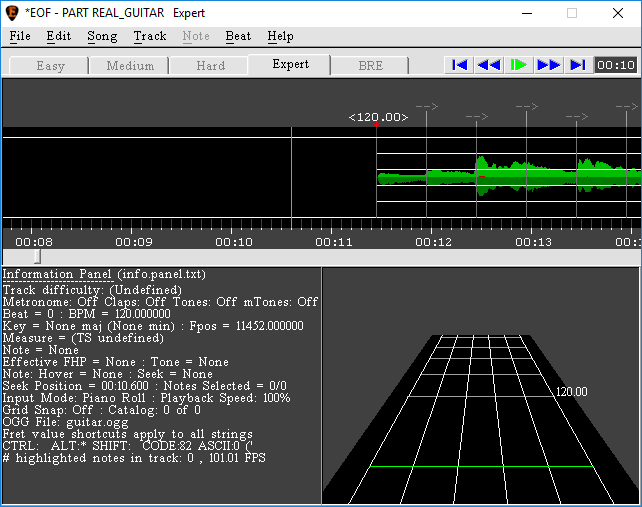
The leading silence will now become visible in the graphical view; the arrow keys can be used to move back and forth to see the beginning of the song. (Remember to use Song > Waveform Graph > ShoworF5 if the waveform does not show up.)
Setting up the tempo map
The next step is critical, and can be tedious; but it’s important to get it right because it makes all the difference to a quality or non-quality product in the end. In a mechanically-generated scenario (for example, MIDI music produced by Guitar Pro or the like), it’s a fairly simple process, since the output will be completely regular. But human beings, especially in a band scenario, are not mechanical devices. and we can expect some variance in tempo beyond the official changes called for by the tune.
Firekorn’s tutorial (see the links in section 1b, just before the video) mentions various tools which can help. I personally like to do it myself the hard way, as it makes me more aware of the details of the song.
In principle, what one wants to do is to set up an approximate tempo map overall, and fine tune where the variance is sufficiently significant.6)The definition of ‘significant’ in this context will depend to some extent upon one’s ability to detect variance in conjunction with what is perceived to be of practical consequence when the CDLC is used. This comes by experience and one can always come back and adjust further if required.
Sectioning the song
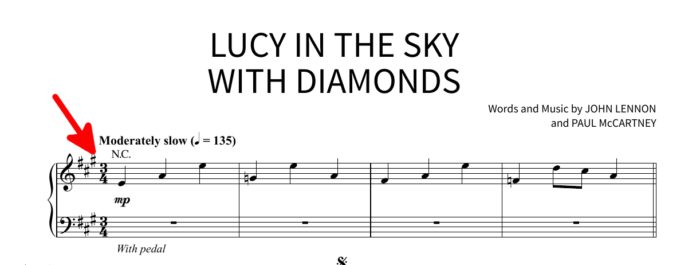
The song begins in three/four time:
This particular tune changes beat a few times, which means that the song had to be partitioned into sections, each of which was then to be fine-tuned individually.7)When such is not the case, one can approach this process globally. Incidentally, we only care about the beat count here; the scale, as indicated by the number of sharps and flats, is of no consequence for the purpose of generating CDLC. Whether or not this is the case will be evident from reading a score of the tune, whether as published in a book or found elsewhere.8)Of course, this is also evident from listening to the beat when playing the song, but that may be tough for some.
The beats per measure change in the following places, in sequence:
to two/two on ‘gone’, in ‘… with the sun in her eyes and she’s gone’
to three/four on ‘Follow’, in ‘Follow her down to a bridge …’
to two/two on ‘gone’, in ‘… with your head in the clouds and you’re gone’
to three/four on ‘Picture’, in ‘Picture yourself on a train …’
to two/two on the third measure of ‘eyes’, in ‘… girl with kaleidoscope eyes‘9)This one is a bit tricky. ‘Eyes’ has two measures of three beats followed by one measure of two beats. Unlike the previous cases, there isn’t a change in wording to signal the change in beat!, followed immediately in the next measure by a final change to
four/four on ‘Lucy’.
So, in principle, there are six separate sections to deal with, where adjusting the tempo map is concerned. For each one,
I ensured that the first beat marker (vertical line) in the tempo map coincided with the corresponding beat
set the timing at that point
counted the measures to the next signature change10)This can be done either by counting manually in the score, or by counting while listening until the next beat change. Either works fine, providing that the score is faithful to the actual music in that regard., and
dragged the n-th measure marker to its correct spot in the graphical display.
In this way, each section began and ended in the correct spot, and there were also the correct number of measures (and thus beats) to match the music in between—though they were not all necessarily in the correct places, given the variances alluded to above.
Stage one (in which Doris gets her oats)
Here’s how this first adjustment worked out in practice, section by section.
Section one
First, I set the time signature to three/four on the first beat of the first measure. Here’s how that’s done:
select the first beat by clicking the bpm (defaulted to 120.00 for the moment) to set the pointer
Beat > Time Signature > 3/4.
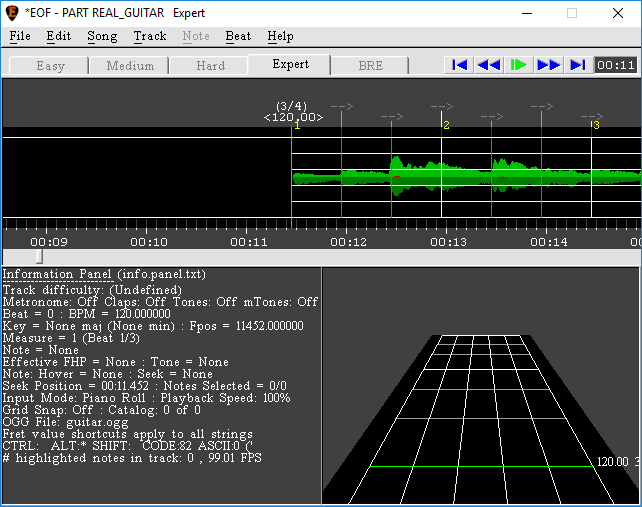
The tempo map reflects the change by placing the new time signature above the first beat and also numbering the measures.
Now, remember that one empty measure is needed before the first beat.11)As I learned from experience, the end-product will not work unless this is done! So the actual first beat has to become the first beat of the second measure. This is done very simply by
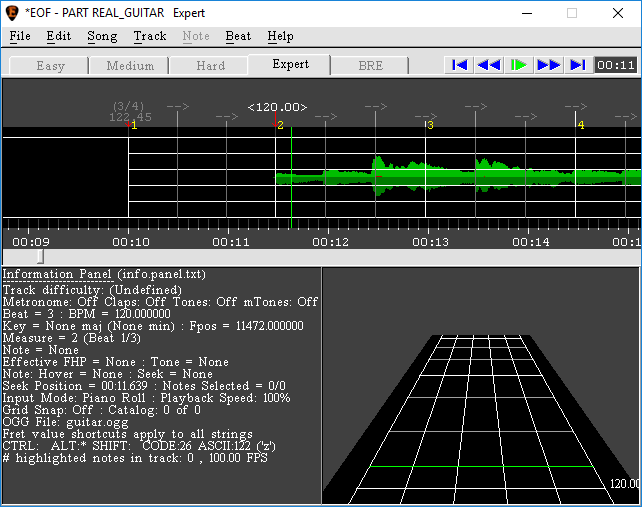
clicking and dragging the anchor (the red downwards arrow under the bpm) of the measure numbered 1 to the 10 second mark, then
dragging the measure numbered 2 to the actual first beat, i.e., the beginning of the wave graph, which anchors it as well.
Note that the first bpm count has been adjusted from the nominal default of 120 to an actual 122.45, reflecting the fact that the first three beats are spread over a shorter time span, resulting in an increase. This is of no consequence whatsoever, and is pointed out here only because the same thing happens any time we move a measure marker to other than a pre-calculated position.
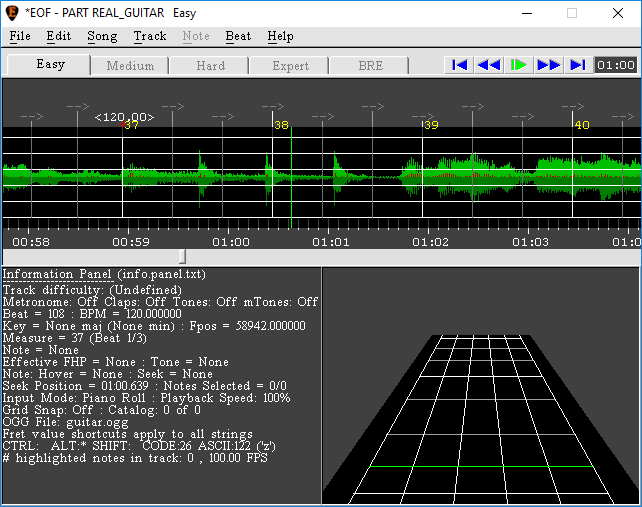
Now, there are 35 measures in this section, which means that I had to move the measure numbered 37 (we start at 2! add 35) to the beat marked by the first ‘gone’ in the lyrics, as discussed earlier. For me, that was just before the 59 second mark, which, before adjusting, was near the end of the measure marked 33. Incidentally—while one should aim for as much accuracy as possible, there’s no need to lose too much sleep here: anchor points can always be adjusted at a later date should this prove necessary.
Note: I used to do this on my Mac, running Windows through the Parallels VM, but lately this has become precarious, so I am now doing it on an actual PC for best results.
I.e., when the first measure is only partial compared to the time signature), add sufficient leading silence so that the first full measure begins in the right spot.
The definition of ‘significant’ in this context will depend to some extent upon one’s ability to detect variance in conjunction with what is perceived to be of practical consequence when the CDLC is used. This comes by experience and one can always come back and adjust further if required.
When such is not the case, one can approach this process globally. Incidentally, we only care about the beat count here; the scale, as indicated by the number of sharps and flats, is of no consequence for the purpose of generating CDLC.
This one is a bit tricky. ‘Eyes’ has two measures of three beats followed by one measure of two beats. Unlike the previous cases, there isn’t a change in wording to signal the change in beat!
This can be done either by counting manually in the score, or by counting while listening until the next beat change. Either works fine, providing that the score is faithful to the actual music in that regard.
Recently, I have been experiencing problems with my ergonomic Bluetooth keyboard1)Microsoft Surface as Apple doesn’t offer one. and my Magic Trackpad 2.
The keyboard has been unavailable at boot-up since, say, a week or two (prior to updating from Catalina to Big Sur, which I’ve just done) .2)I understand that non-Apple products can be expected to take a little longer to be recognized—though I don’t know why—but it makes no difference how long I wait. Once I’ve logged in, it becomes available without further problem and functions normally. The trackpad, on the other hand—also a Bluetooth advice, but Apple-made, obviously—is available as soon as I attempt to use it but is intermittently sluggish after boot-up. In the latter case, the problem seems to have begun with the move to Big Sur.
The following solutions have been proposed by Apple:
increase the tracking speed on the trackpad
unpair and repair the devices
charge the trackpad to 100%
enter Safe Mode and see whether the problems persist
I have so far attemped solution ##1, 2, and 3, as well as the first step described with regards to resetting SMC (viz., holding the power button down 10 seconds, then booting up) for the trackpad, so far without any improvement to trackpad erratic behaviour.
I am delaying doing the attempt with the keyboard as I have in the past found pairing the Microsoft Surface keyboard to be difficult, and, as I’m in the middle of my teaching term, can’t afford the problems which would ensue should the keyboard not repair. I’ll fiddle with this at end of term should the issue persist. (It is, after all, not that big a deal to enter the boot-up password on the built-in keyboard, as I don’t use a docking station.)
New problem: built-in keyboard
This morning (ca. 5:15 am), I experienced a new problem at boot-up: I was unable to enter the password at boot-up. It was not just invisible, the keys were not registering at all!
I powered down and rebooted, to no avail. Eventually, I was offered the cryptic advice that I should reboot which would put me into Recovery Mode, where I could address the issue.
I did so, and thanks to the trackpad, was able to choose a bullet-point option corresponding to non-functional keyboard, and was then invited to turn off FileVault. As I had no other choice, I did that, and was able to log in normally.
What is that all about? I posted an update to my Apple contact through the messaging system as this is not only worrisome but potentially related to the problems noted above.
Solution attempts, pass two
After today’s two lectures, I decided to shutdown the machine and continue the SMC reset procedure (shut-down, hold left-control, left-alt, right-shift for 7 seconds, then press the power button, hold for another 7 seconds). The Mac booted up, and the Bluetooth keyboard was available to type the password!
This was not quite what the script predicted: I was supposed to push the power button myself after the second set of 7 seconds to boot up the machine. So I shut the machine down again, waited a few seconds to be sure it was good and truly shut down, then powered it up again.
The Bluetooth keyboard was still available for log-in. So it looks like I’ve licked the Bluetooth keyboard part of the issue, but I’ll keep an eye on it to be sure. Let’s also see whether the trackpad behaves any better now.
Update
After a few days, the Bluetooth keyboard continues to be available at boot-up, however the trackpad continues to be erratic.
I read the two articles recommended above by Apple, but found nothing there which was relevant and which I’d not already tried.
I tried booting up in Safe Mode. As far as I could see, the trackpad functioned normally; but unfortunately, I couldn’t do any real work in that mode (besides the fact that everything else performed poorly) so it didn’t prove to be much of a diagnosis. When I rebooted normally, the trackpad behaviour was as bad as ever. Incidentally, I did turn it off and on again, as I’d heard that this sometimes makes a difference, but it did not.
The reset of the SMC cured the Bluetooth keyboard not being available prior to login.
Nothing made any difference to the trackpad issue. It works most of the time, and drags occasionally. As far as I can see, this behaviour coincides with the upgrade to Big Sur, so it’s either a Big Sur issue, or coincidence,3)Which does happen; it turns out that this was the case with my last problem, as it happens. or a hardware issue. The trackpad is only a few months old, so I’m inclined to one of the two software issues for the moment, but if we can’t fix it, then … whatever remains (hardware), however unlikely, must be the truth!4)That said, having temporarily paired the old Magic Trackpad and disabled the new one made no difference either, so I think we can eliminate the trackpad hardware.
I would really like to know why the laptop’s built-in keyboard failed to respond, and what on earth turning off FileVault had to do with it?5)This also suggests to me a software issue on the previous point. And I would add that occasionally, I seem to sense a lag in the Bluetooth keyboard response, as well, though that is much less obvious than the trackpad issue, which is glaring.
Two other things which one might try:
Disable OneDrive. Typically, there is very little going on in the OneDrive space, but it does poll regularly so this may be worth a shot.
Turn off wi-fi, since it is only needed for AirDrop; otherwise, internet is provided by ethernet to router. I have been told in the past that having both active can lead to potential issues.
No cigar.
Chat with Apple
My support person called back on Saturday, 5 December. Apparently, we’ve pretty much covered all possibilities, with the exception of re-installing Big Sur or wiping the system and re-installting Big Sur and the file system from backups.
She was skeptical of the value of this, as that was done recently, towards the tail end of the Catalina OS. I indicated that I could try the first option at some point when I had some time available, but as for the latter, that would have to wait until end of term, since it would be long and tedious and impracticable in the mean time.
I have tried neither of these—yet.
Another internet search
I’m not the only one with Bluetooth problems, it seems; there are many reports of Bluetooth audio problems, but I haven’t tried audio, though maybe I should, just to see?
One site suggested deleting the associated plist file, so I decided to try that. Apple had suggested a similar procedure for one of my earlier problems, after all.
Navigate to /Library/Preferences
Delete or move com.apple.Bluetooth.plist6)I opted to rename it to com.apple.Bluetooth-old.plist.
I understand that non-Apple products can be expected to take a little longer to be recognized—though I don’t know why—but it makes no difference how long I wait.
That said, having temporarily paired the old Magic Trackpad and disabled the new one made no difference either, so I think we can eliminate the trackpad hardware.
This also suggests to me a software issue on the previous point. And I would add that occasionally, I seem to sense a lag in the Bluetooth keyboard response, as well, though that is much less obvious than the trackpad issue, which is glaring.