Having finally repaired the stratocaster input jack, I decided to take it for a test drive as my first venture into Rocksmith on the Dell PC.
Guess what? Rocksmith told me the cable wasn’t connected. Aw, man!!
I spent most of the afternoon debugging this. I updated all kinds of drivers and GEForce Experience, tried to update Direct X run time module(s),1)Apparently I had the latest version already. updated the BIOS with a flash, 2)All the while holding my breath!, tried all four USB 2.0 ports, for good measure tried USB 3.0 too,3)Apparently the cable isn’t compatible with those, which may be dubious information, but as it wasn’t working anyway …. and finally tried a powered USB hub. Nothing doing.
So then I installed the Discord app and posted a query on the CustomsForge channel. Apparently power issues are the most common cause of the so-called Code 10 error I was getting4)This is visible from the Device Manager, by the way. but I’d already tried that.
While I awaited a reply, in total despair I tried the other ports on the powered USB hub. It turns out that the one nearest the power supply input worked!!
This sounds like a potentially unstable solution, so I’ll likely obtain another powered USB hub if someone gets back to me regarding that.
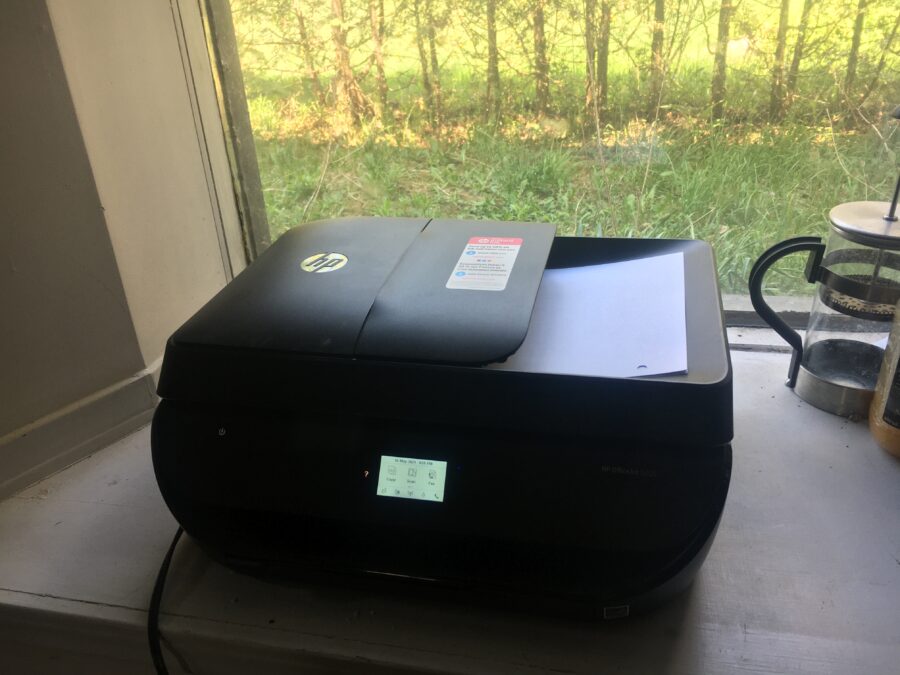
I had planned to use the new Epson scanner to scan my Arabic homework, but then realized that there was no sheet feeder, so opted for using the HP Officejet instead.
So I installed the software for that onto the Dell PC.
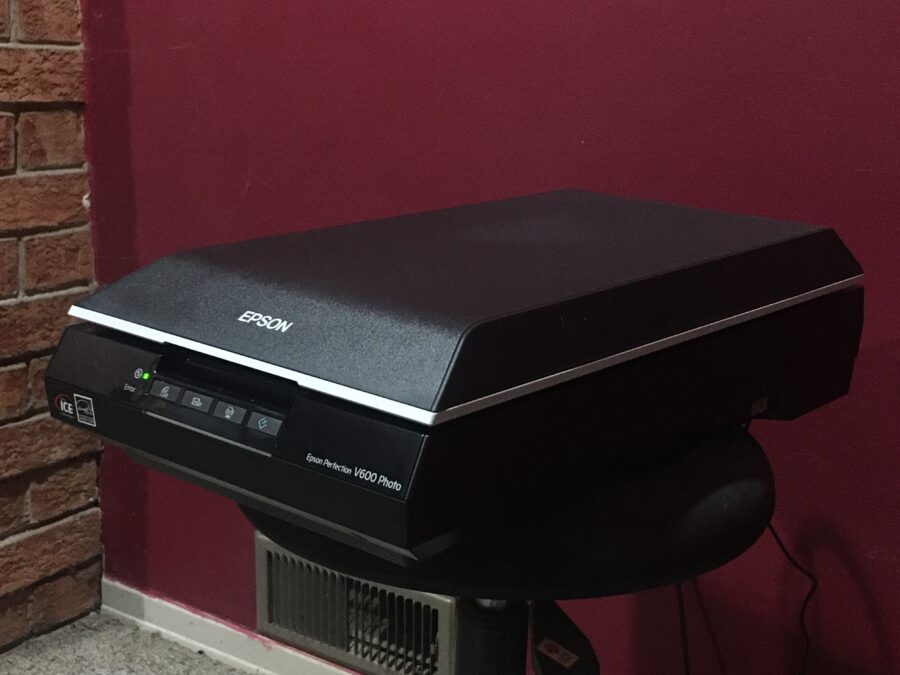
Today, as my left calf was giving me considerable grief following yesterday’s rope skipping incident, I decided to do ‘relaxing’ things. Setting up the slide scanner which arrived a few weeks ago seemed a good idea.
It’s pretty clear that the instructions were written in the dark ages and never updated; they referred to Windows 7 and Windows 8; problem resolution suggested verifying that the computer was USB-compatible (after suggesting one make sure the thing was in fact plugged into a USB port!), etc. I can only assume that they are in competition with HP for the Tech Darwin Award of the Century.
Minimal instructions on set-up and a CD-ROM. Going to the Epson on-line site did provide a download option, so did that.
Then spent a frustrating half hour trying to get the thing to even come on. Got the voltage tester out to make sure there was in fact juice coming out of the adapter, and yes indeed, there was. That’s when I discovered the ‘On’ switch cleverly hidden on the right side of the unit, near the back, in a recessed cavity. That would explain why there was nothing obvious on the front, and I had to revise my initial assumption that the thing must just always be on.
It took me another hour to figure out how to scan slides. Pushing the buttons on the front of the unit as suggested in the instructions did nothing whatsoever. I thought that this being Hell—pardon me, Windows—maybe I had to reboot to activate the driver. Uh, no. Ok, let’s do it the other way and run the software from the computer end.
I kept being told that no document was found. I assumed that the fault lay in my scanner setting choices, none of which was ‘slide’, ‘diapositive’, or the like. It turns out that I’d placed the slide holder the wrong way around onto the scanner bed. I must take the blame for not having used a microscope to check the details in the image in the instructions; mea maxima culpa!
Finally got that sorted out, and found that the ‘scan’ option was greyed out until I’d done ‘preview’ first. My apologies; I haven’t visited the 50s in some time. I then discovered that *after* the preview the button on the front of the scanner worked. Um, ok, but if they force me to start at the computer end, what’s the point? I assume that there’s something I’m missing somewhere. Time to submit a ticket to the support animals … again ….
I pulled four slides from an arbitrary Paximat1)A projector which I inherited; the slides are placed into long plastic container which are then placed into the projector. box; I noticed that that particular part of the box was labelled ‘Wittelbach’ and that the slides themselves were dated to various days in September 1995.2)By the way, I adopted a convention for labelling the slides according to where I get them from; in this case PM-01-YYMMDD, where ‘PM-01’ refers to ‘Paximat Magazin 01’ and ‘YYMMDD’ refers to the date on the slide. If slides are undated I’ll come up with something else (like the slot number) and where there are multiple slides for a given day I’ll just add a numeric suffix.
This process (even at 300 DPI) is low as molasses in January in the Antarctic. Anyway, here are the results of the first attempt.
By the way, I adopted a convention for labelling the slides according to where I get them from; in this case PM-01-YYMMDD, where ‘PM-01’ refers to ‘Paximat Magazin 01’ and ‘YYMMDD’ refers to the date on the slide. If slides are undated I’ll come up with something else (like the slot number) and where there are multiple slides for a given day I’ll just add a numeric suffix.
I started working on Blender scripting two years ago with a view to creating model submarine parts.
But I’d forgotten how to get started, so I just watched a simple tutorial to help refresh my memory.
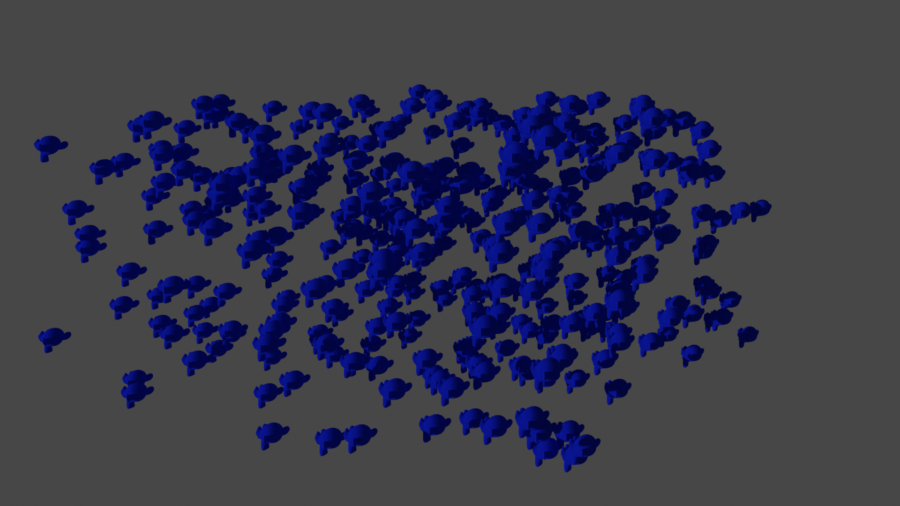
Here’s the code to produce the monkeys.
import bpy

from random import randint

# Clear the workspace
bpy.ops.object.select_all(action='SELECT')
bpy.ops.object.delete(use_global=False)


# Generate some randomly spaced monkeys
for _ in range( 0, 400 ):

    # Pick a random location within a given space
    x = randint( -20, +20 )
    y = randint( -20, +20 )
    z = randint( -10, +10 )

    # Add a monkey
    bpy.ops.mesh.primitive_monkey_add( location = ( x, y, z ) )

    # Change the resolution of the current monkey.
    # Shade smoothing reduces the number of vertices and thus the
    # load on the processor.
    bpy.ops.object.modifier_add( type='SUBSURF' )
    bpy.context.object.modifiers[ "Subdivision" ].levels = 2
    bpy.context.object.modifiers[ "Subdivision" ].render_levels = 1
    bpy.ops.object.shade_smooth()
Having come up with a preliminary design for a deck using software I found on-line, I concluded that the information it made available was not adequate for filing a building permit, so I took a look at Sketchup, which I had heard was simple and free.
Well, apparently the free version is a browser-only version. That’s not an issue, except that the useful tools for deck design are extensions and those don’t seem to be available for the browser-only version.1)Note that I said ‘seem’; I could be wrong, but I couldn’t find any useful information on the subject. As is so often the case, on-line help I found was outdated. And given what I saw in the interface, I decided I’d be better served investing my time in reacquainting myself with a much more useful tool I’ve used in the past.
So I installed Blender. Now, I have to relearn how to use it!
Note that I said ‘seem’; I could be wrong, but I couldn’t find any useful information on the subject. As is so often the case, on-line help I found was outdated.
I’ve been using CDLC (‘custom downloadable content’) courtesy of Customs Forge for several years on the MacBook Pro, but I’d not got around to setting that up on the Dell G5 until today. I also created a folder CDLC within the Rocksmith dlc folder so I can keep any CDLC I instal organized.
So I did that! I plan to move all non-serious work to the Dell in due course. That includes games ….
I was working on another martial arts page having to do with chishi (not yet completed) and decided to start migrating non-work-related bibliography items to the PC.
This meant installing Zotero and the Firefox connector, and GIMP so I can process images for this website.