
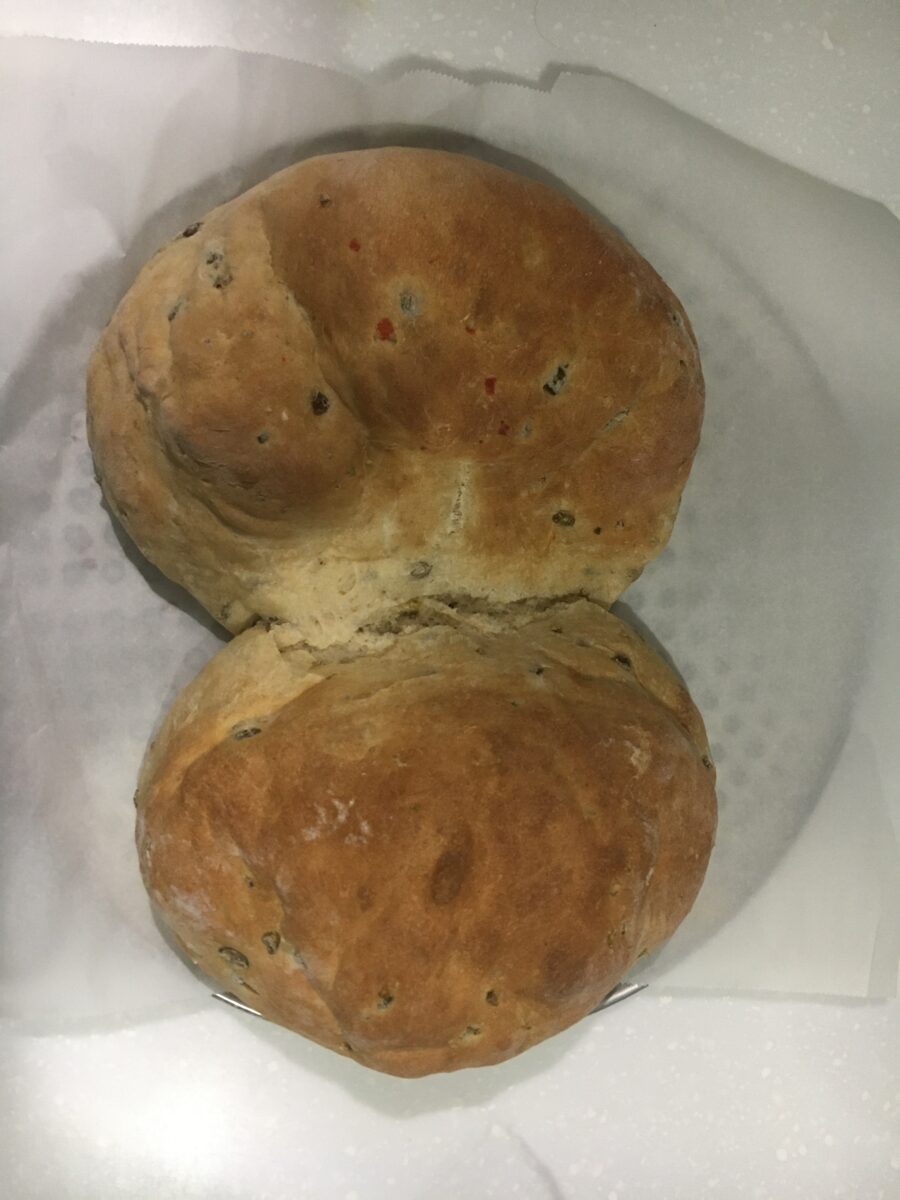
I discovered last night that the olives in the refrigerator were developing white mould on the surface of the brine. This was no big surprise, in fact, I’m surprised it didn’t happen sooner, since the refrigerator in question hasn’t worked properly since the beginning of the pandemic shutdowns in March. The replacement hasn’t arrived yet (it’s due on November 19th) and I simply didn’t get around to doing anything with the olives.
Preparing the olives
So, I rinsed them multiple times in the sink and left them to soak overnight and packaged them into freezer bags this morning. I tried a few; they didn’t taste of mould at all, but they also didn’t taste of brine anymore (big surprise!) so I thought I should maybe cook with them.
Olive bread—attempt one
I did a quick internet search for an olive bread recipe, and found this one, suited to the bread machine.
The first time, I forgot to put the chopped olives into the nut and raisin container in the lid and dumped them in with the regular dough ingredients instead. It’s a feature I’ve only used once or twice, and that was long, long ago!
Not surprisingly, the dough was far too wet; I ended up adding one extra cup of flour part way through the cycle. It was still a little wet, but rose nicely. My wife suggested it might not cook entirely on the inside, so I ended up cutting it in half to make two smaller loaves and rising it a little longer in a slightly warmed oven. It seems to have turned out just fine; I gave one each to two of our neighbours.
Olive bread—attempt two
The second time, I was more careful, and put the chopped olives into the lid compartment as suggested. This time, the olives were not mashed up as much; the dough was still too wet, to my mind, but one third of a cup of flour seemed to do the trick.
The loaves didn’t rise quite as well as the first time around, for whatever reason, but the results were ok.
Overall assessment
The recipe I chose works well enough as a starting point—reviews on its page rave about it, in fact—but I think it needs some customization:
- Assuming one would like to keep to the specified flour quantity (3 cups),1)This is the maximum recommended for my machine, so I’m going to go with this. the water should definitely be reduced. An equivalent challah loaf nominally calls for 1 cup 1 oz of liquid, including egg (so about the same specified here) but I’ve found that reducing this to 7 7/8 oz is preferable. Add to this the fact that olives contain some moisture, and I’m inclined to try 7 1/2 oz next time around and go from there.
- 3/4 cup of olives came out to exactly 100g the first time I measured them out. I found the result a bit sparse in that department, so I think I’ll go for 150g next time.
Notes
| ↑1 | This is the maximum recommended for my machine, so I’m going to go with this. |
|---|