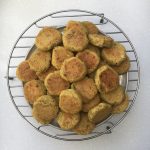
Lebanese falafels
Falafel is a delicious Middle-Eastern appetizer which has become popular in the West over the past several years. It’s made from a paste of chick peas and/or fava beans, and a mix of onions combined with herbs and spices. Usuallly it is served with pickled turnip, parsley, and tahini sauce in a pita, but of course you're the boss!
Servings: 21 falafels
Calories: 84kcal
Equipment
- Scale
- Large bowl
- Cutting board
- Kitchen knife
- Small bowl
- Oven and baking sheet or electric frying pan
- Spatula
- Food processor
- Measuring spoons
- Soup spoon
Ingredients
Main ingredients
- 400 g chickpeas dried
- 400 g fava beans dried
Flavouring
- 25 g cilantro mainly leaves, stems as desired
- 25 g Italian parsley mainly leaves, stems as desired
- 45 g red onion or other type, as preferred
- 25 g green onion stalks trimmed
- 15 g garlic cloves, peeled
- 1 g chili pepper red or green, or to taste
- 1 tsp ground cumin
- 1 tsp ground coriander
- 1 tsp chili powder
- 2 tsp chickpea flour
- 1/4 tsp baking soda
- 1 tsp salt to taste, or omit
- black pepper ideally freshly ground, to taste
Cooking
- 30 ml safflower oil or other, as preferred
Instructions
Advance preparation
- Soak the chick peas and fava beans in water in separate containers. Chick peas require about 4 hours while fava beans do better overnight; for convenience, both can be done overnight with no negative consequences.
Bean preparation
- The following day, continuing to keep the chick peas and fava beans separate, drain them and then rinse them with fresh water (this reduces the potential for abdominal gas emissions!), then peel them. In some cases, this can be done by squeezing them between thumb and forefinger; in more stubborn cases, pressing and rotating between two breadboards works quite well.
- Rinse the beans several times with fresh water until it no longer becomes cloudy. Leave them submerged until it is time to grind them.
Preparing the flavour mix
- Chop cilantro, parsely, onion, green onion, and garlic, add the remaining flavouring ingredients, and blend using a food processor (in batches as necessary, in which case mix together at the end for a homogeneous result).
Grinding the beans
- Still keeping the two types of beans separate, drain well but do not allow to dry, then grind in the food processor (different types of beans have a different consistency, so mixing them before grinding is likely to produce a mixed result—no pun intended). Continue until the beans are relatively fine (one or two may escape the chopping) without being reduced to a paste.
Finalizing the mixture
- Now combine all three batches of ingredients and stir until well mixed.
- Measure out a consistent quantity of mix, roll in the hands, and, f not deep-frying, compress slightly to form into patties. I use a scale and measure 35g per falafel, but using a spoon for general consistency works well enough and is certainly simpler.
Cooking the falafels
- Traditionally, falafels are deep-fried; but they can be pan-fried with a bit of oil or in a (so-called) non-stick pan. Alternatively, they cabn be baked in the oven at 400℉ (200℃), with or without oil. While not necessary, the oil helps to brown and crisp them.
Notes
- I’ve found that on average, 400 g of dried chickpeas produces 723 g soaked and peeled 400 g of dried fava beans produces about 693 g soaked and peeled; a 540 mL tin of fava beans yields 286 g peeled. (Sorry, I've forgotten the yield of a tin of chickpeas.) Various cooks feel that tinned beans have soaked for too long and tend to produce too wet a mix and/or contain too much salt (though salt-free is available in some places). Feel free to experiment for yourself!
- FYI: 540 mL = 19 oz. Canada is a bit schizophrenic, since we have the metric system but for trade reasons try to accommodate the US. mL is a liquid measurement!! In proper metric cooking, dry ingredients are weighed on a scale. That’s my preference as it makes for consistent results, which is why my recipes are a little schizophrenic too….
- Tinned fava beans peel easily using fingertips. Home-soaked (rather than tinned) chickpeas require a little more pressure, which is probably not an issue for most people. However, I have wrist damage from excessive typing, so I prefer the breadboard system alluded to in the instructions.
- Feel free to use regular flour; I have chickpea flour on-hand.
- The original recipe called for 2 tablespoons of salt! Presumably this is the US measure (where 1 tbsp = 3 tsp) rather than the Commonwealth measure (where 1 tbsp = 4 tsp, which theoretically applies in Canada too, but it varies depending on the supplier of measuring spoons). This is, in my view, far too much, and in fact, the recipe may be tolerable for some with no salt at all. Be your own judge!
- Ovens vary, so keep an eye out the first time! You’re looking for a medium-dark brown colour, rather like a light coffee bean.